

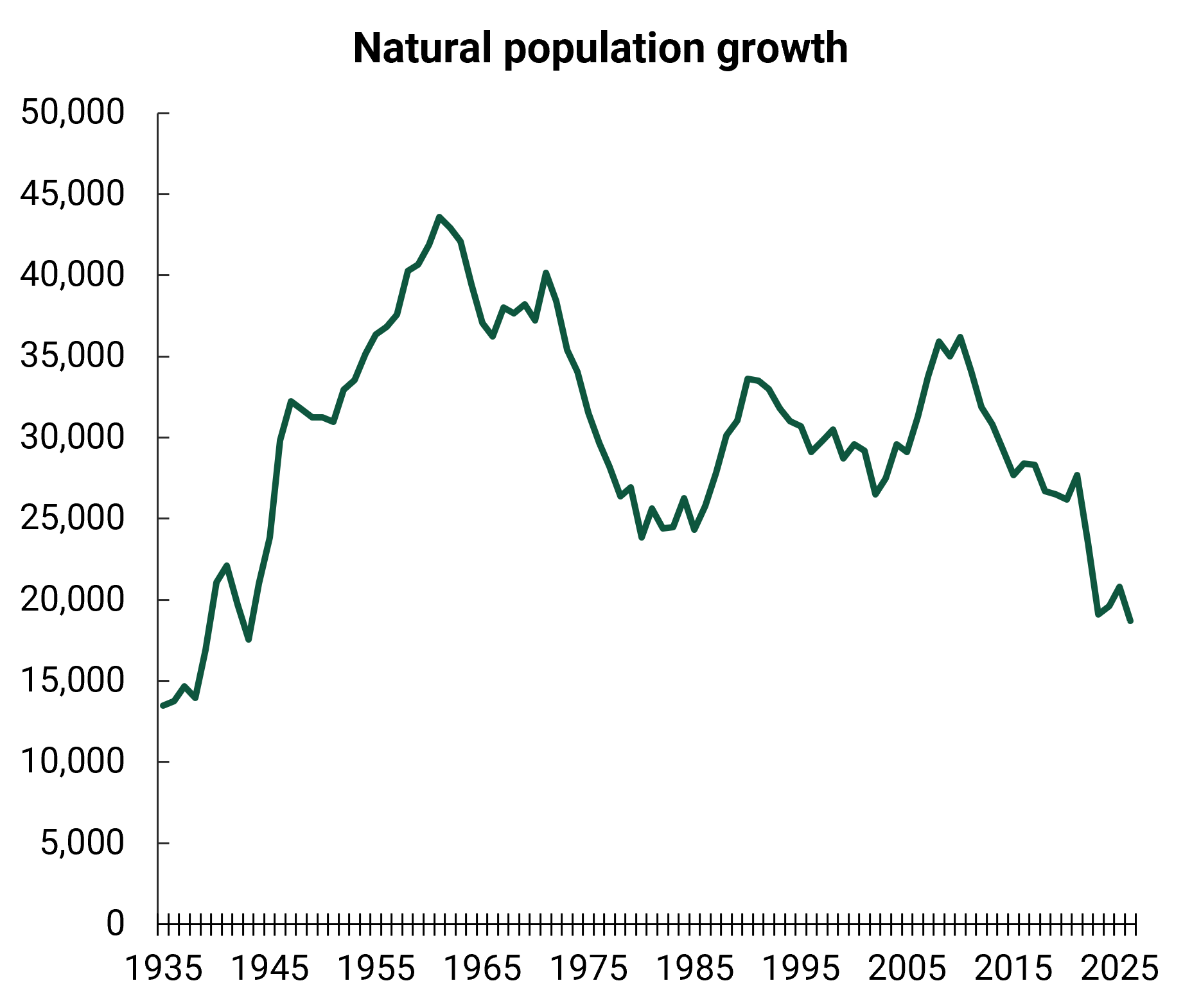
Over the year to June 2026 natural population growth was 18,700 people – the lowest since 1943, 83 years ago.
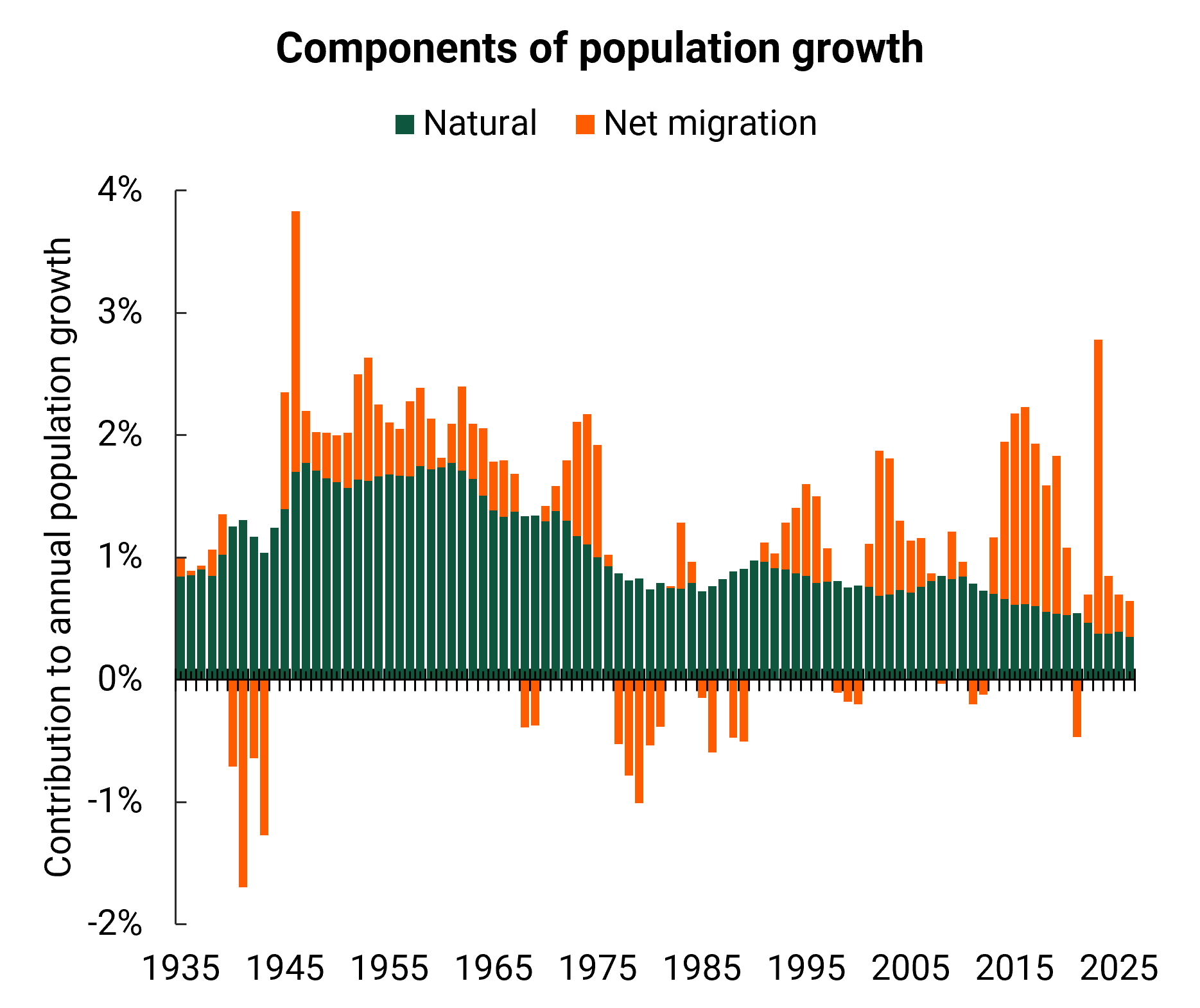
Of course our popualtion has grown, so the comparison should also be across the contribution to population growth.
The rate, or the natural contribution to population growth, is now 0.35%, vs over 1.5%pa during the baby-boom era (until around the early 1960s), then trended down and settled around 0.8%pa between 1980 and 2010 (that’s boomers having babies and increasing life expectancy really showing up in the data) and has been trending lower since.
The two charts below show the natural population growth in persons, and as a contribution to population growth.
Population growth is not a necessity per se, rather it is a core assumption in how we have set up our society, from taxes, spending, investing and borrowing decisions: there will be a bigger and richer generation that comes later, meaning we can run up some (or too much) debt now.
For a long time, this was true. Nationally, we still have some time. But not so locally, as the chart below shows – 18 districts now have deaths exceeding births.
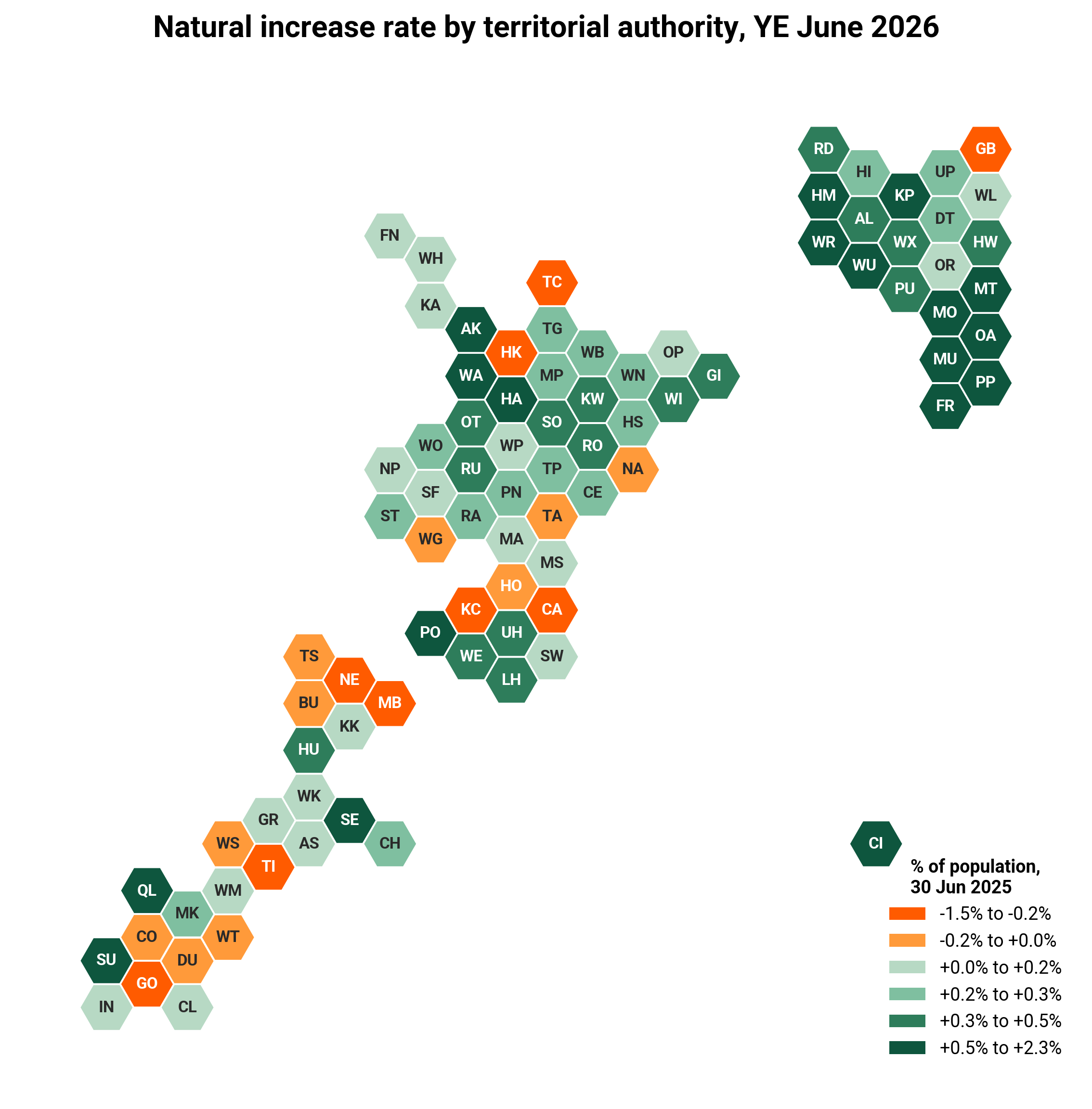
The other side is strong growth in places like Selwyn, Queenstown-Lakes, Auckland, Waikato, Hamilton and Porirua – because these places are young and families are moving there.
Population growth is made up of births, deaths and migration in and out – regional and international.
Births, or fertility rates, have fallen for various reasons, including reduced infant mortality, increased cost of housing, opportunity cost of time out of work, cost of raising children, and shifting values.
Deaths have increased mainly because of an ageing population. While longevity is still increasing – and is to be celebrated – death remains an inevitability.
Slowing and shrinking natural population growth matters. Natural population growth tends to be fairly predictable – so you can largely bank this.
Migration, both regional and international, is more variable, affected by life decisions (for example to go to university), economic conditions (employment opportunities, housing, etc) and immigration policy. None of these can be banked.
Those districts where deaths exceed births are a natural experiment of ageing in New Zealand. The causes and local conditions are not uniform.
Some are retirement hotspots – encouraged by their sunshine, natural beauty, amenities and housing arbitrage (being able to sell their working life homes to fund their retirement home and lifestyle).
Some export their young (and more), mainly for education and jobs. Most do not return.
Others import workers from other parts of the country and world. I saw this in Balclutha – where Samoan is now the second most spoken language – because of Samoan workers at the freezing works in Finegand. Or the past immigrants who make up a large Cook Island community in Tokoroa. In both examples, these places experienced intense labour shortages.
Work and housing are the key drawcards for provincial NZ. When there is work, even if pay may appear modest compared to cities, lower cost of housing and little congestion can mean more money at the end of the week and a better lifestyle.
Ageing is a specific risk for local governments. Many have ageing infrastructure that has not been maintained for decades. Climate change is adding greater risk and cost. Older people – often with fixed incomes – cannot sustain large increases in rates, which are required to pay for new infrastructure and maintain what they have now.
For many places, they need to have a plan for how they would manage a shrinking population. But that does not mean giving up. Many have jobs and homes and other amenities – they could try connecting this to disaffected city dwellers, stuck on a hamster wheel of work, long commutes, congestion, high housing costs and little free time.
Could there be a win-win and buy us some time as we move to a flat or falling population reality?
Thank you for your clarity and human warmth.
We have one human genome full of cultural diversity.
Yes I am very aware of my empty spare room at present.
It has sheltered a dozen people with various issues over two decades.
True Circles of power are my Joy.
Great analysis!🙏